
Top AI Tools for Business Growth and Innovation in 2026
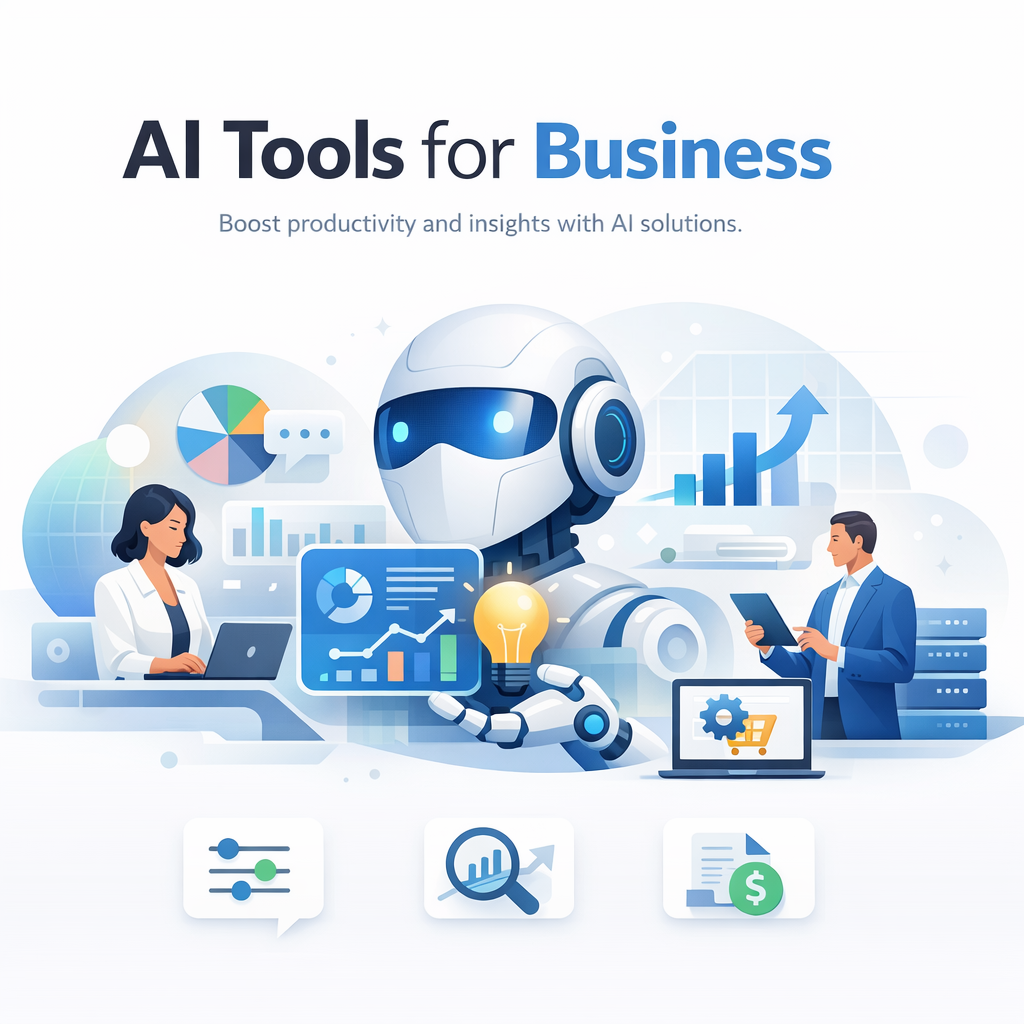
In the rapidly evolving digital ecosystem of 2026, Artificial Intelligence (AI) stands at the heart of business transformation. From automating routine tasks to enabling real-time data-driven insights, AI technologies are driving the next wave of business growth and innovation. As organizations embrace intelligent tools, competitive advantage no longer depends solely on human creativity—it thrives on how effectively companies leverage AI for smarter, faster, and more efficient decision-making. This article explores the most powerful AI tools in 2026 that are redefining productivity, customer experience, and business success.
Understanding How AI Is Reshaping Businesses in 2026
AI has matured into a strategic necessity for businesses in 2026, weaving intelligence into every function, from management to marketing. Organizations no longer see AI as a novelty but as the backbone of operational efficiency. With advanced algorithms, deep learning models, and improved natural language processing, companies can now predict market shifts, optimize internal processes, and respond in real time to emerging opportunities. This integration of AI across industries fosters innovation that is both practical and transformative.
More companies are investing in AI-driven tools to handle complex datasets, uncover hidden patterns, and generate actionable insights that guide key decisions. Whether it’s predictive analytics, automated customer support, or intelligent content generation, businesses are finding new ways to streamline tasks while staying agile. The global business environment is no longer about who has the biggest budget—it’s about who harnesses AI more effectively to solve problems faster and smarter.
In 2026, collaboration between humans and machines has reached new levels of synergy. Instead of replacing human roles, AI augments them—allowing teams to focus on strategy and creativity while machines handle analytical and repetitive work. This human-AI partnership enhances productivity, speeds up innovation cycles, and ensures that businesses remain competitive in a hyper-digital world.
The Most Powerful AI Tools Driving Growth This Year
Several new AI tools are shaping the business landscape in 2026, bringing unprecedented capabilities to organizations of all sizes. Among the frontrunners are OpenAI’s enterprise suite, Google Cloud Vertex AI, Microsoft Azure AI, Anthropic’s Claude 3, and IBM Watsonx. Each of these platforms leverages cutting-edge generative AI and machine learning models tailored to diverse business applications—from automating complex workflows to delivering personalized customer experiences.
- OpenAI Enterprise Suite helps businesses integrate large language models into internal systems for communication, market analysis, and even software development.
- Google Cloud Vertex AI empowers data scientists and developers with end-to-end ML pipelines that accelerate model training and deployment.
- IBM Watsonx focuses on trusted AI governance, ensuring that businesses scale AI ethically and securely.
Beyond these tech giants, numerous emerging startups in 2026 are innovating rapidly. Tools like Jasper AI for enterprise content automation, Runway ML for creative visual generation, and Synthesia for AI-driven video production give businesses new ways to communicate and market effectively. These platforms reduce production time, control costs, and make high-quality output accessible to companies regardless of technical expertise.
Collectively, these AI solutions are enabling a new standard of agility and personalization. Businesses can now pivot strategies based on instant AI-powered insights, test marketing campaigns before they go live, and automate backend operations with remarkable precision. The democratization of AI tools ensures that growth is no longer reserved for big corporations—small and medium enterprises (SMEs) also have the power to innovate on a global scale.
How Automation and AI Streamline Daily Operations
Automation remains one of the strongest advantages of AI in 2026. Intelligent systems now manage inventory, handle recruitment, and even conduct real-time customer support without human intervention. Tools like UiPath, Zapier AI, and Automation Anywhere provide seamless integration between applications, reducing manual effort and freeing employees to focus on strategic tasks. Business leaders can allocate resources more effectively, leading to improved efficiency and productivity.
Companies that adopt AI-driven automation experience measurable cost reductions and better time management. For instance, AI-powered workflow management tools can analyze past performance data, forecast project timelines, and allocate team members accordingly. When combined with natural language processing, chatbots and virtual assistants automate hundreds of customer interactions each day, ensuring consistent and 24/7 service quality.
Through advanced robotic process automation (RPA), repetitive and error-prone tasks—such as data entry, invoice processing, and reporting—are completed in seconds. This synergy between AI and automation allows companies to scale effortlessly while maintaining operational transparency. The result is a leaner business structure capable of adapting to shifting market conditions quickly and efficiently.
Leveraging Predictive Analytics for Smarter Decisions
Predictive analytics remains a cornerstone of data-driven businesses in 2026. By interpreting historical data and combining it with real-time information, AI tools like Tableau GPT, Salesforce Einstein, and DataRobot AI Cloud empower companies to anticipate future outcomes. These tools help organizations make proactive decisions rather than reactive ones.
Predictive analytics goes beyond forecasting—it identifies emerging trends, potential risks, and customer behavior patterns. Businesses leverage this information to refine marketing strategies, optimize pricing models, and prevent supply-chain disruptions. With AI models continually learning and evolving, the precision of these forecasts improves over time, giving executives a more accurate view of what’s coming next.
In practice, predictive models assist organizations in setting smarter goals and managing uncertainty. For example, financial institutions use AI-powered analytics to detect fraudulent transactions before they occur, while retailers apply predictive tools to forecast seasonal demands and manage inventory efficiently. In 2026, companies that harness these insights can move faster, make wiser choices, and maintain a lasting competitive advantage.
Boosting Customer Engagement Through AI Innovation
AI has revolutionized how brands interact with their customers by fostering deeper, more meaningful connections. Modern businesses rely on AI-driven engagement platforms such as HubSpot AI, Drift Chatbots, and Adobe Sensei to personalize communication and tailor marketing strategies. These solutions analyze customer data across multiple touchpoints—social media, websites, and email campaigns—to deliver hyper-targeted content that resonates with each audience segment.
Personalization has become the currency of customer loyalty in 2026. AI tools track customer preferences, predict future purchasing behaviors, and recommend products or services based on real-time analysis. With virtual sales assistants and smart chatbots powered by generative models, interactions feel natural and human-like, improving satisfaction and conversion rates.
Beyond sales, AI’s role in customer retention and feedback analysis is essential. Businesses use sentiment analysis tools to gauge public perception, identify pain points, and respond instantly. The ability to process millions of data points within seconds helps companies maintain strong relationships and nurture brand trust. By merging empathy with analytics, AI ensures that customer engagement is not just automated—but genuinely insightful.
The Future Outlook of AI Tools for Business Success
The future of AI tools in business extends far beyond automation and analytics. In 2026 and beyond, the next frontier involves AI-driven decision intelligence, autonomous business ecosystems, and quantum-enhanced analytics. Businesses will continue to evolve through tools that combine contextual understanding with predictive reasoning, allowing AI to act as a strategic advisor rather than a simple assistant.
Ethical AI, transparency, and sustainability are becoming top priorities as governments and industries collaborate to establish clear regulatory standards. Companies adopting AI responsibly stand to gain not just financially but reputationally. AI auditing platforms and explainable AI frameworks are now standard, ensuring fair and non-biased decisions across sectors such as finance, healthcare, and manufacturing.
Looking forward, the fusion of AI with emerging technologies—like extended reality (XR), blockchain, and edge computing—will redefine how organizations operate. From immersive virtual offices to decentralized, AI-managed workflows, the businesses leading this transformation will shape the foundation of a smarter and more resilient digital economy. The message is clear: those who continue to innovate with AI in 2026 aren’t just keeping up—they’re defining the future.
Artificial Intelligence has transitioned from a supportive technology to the driving engine of business innovation in 2026. The top AI tools empowering automation, predictive analytics, and customer engagement are no longer luxuries—they’re strategic imperatives. Organizations that embrace these technologies not only enhance efficiency but also unlock untapped creative potential. As the line between human insight and machine intelligence continues to blur, the ultimate differentiator will be how businesses use AI not just to grow—but to innovate with purpose, agility, and vision.